Corpus Analysis and Reflection
NOTE: My screenshots have null space at the bottom due to my dual-screen setup. I’ll provide links for Voyant Tools, and the screenshots in Antconc may be opened in another tab so they can be viewed better.
For my latest DIGIT assignment, I used Voyant Tools and AntConc to assess William Shakespeare’s Hamlet and Mary Shelley’s Frankenstein. Stylistic differences aside, both stories share a common theme: life and death, and how they influence the actions of others. In this essay, I will reflect on my analysis of the stories, using images and links to support my points.
To Name or Not to Name…
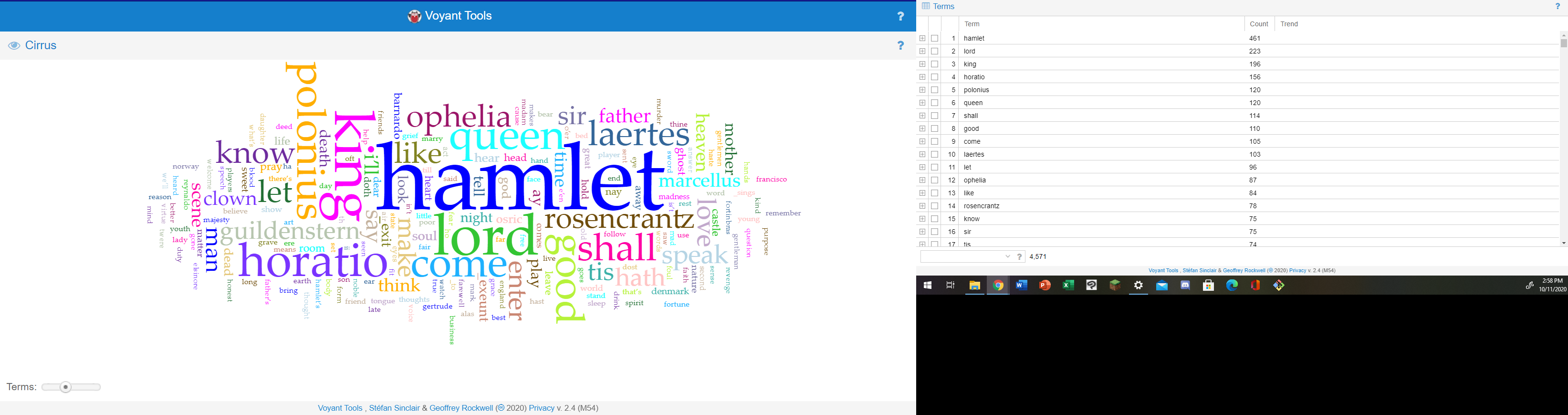
Shakespeare’s famous plays have stood the test of time, and Hamlet is among them. When analyzing the text, I noticed that the most commonly used terms were character names and titles, which are understandable given that the story is formatted like a script. commonly used words that stood out to me were good, know, love, and father. Given that Hamlet blames his Uncle for his Father’s death, his disappointment in Gertrude for marrying him, and his desire to avenge his father, it makes sense that these terms appear frequently. Ironically, despite the story’s themes of life, death, and revenge, only a handful of words in the top one-hundred refer to subject (death, dead, madness, and blood). This surprised me because I saw Hamlet as someone who was obsessed with revenge, but according to the text, it was discussed less than I thought.
View the word cloud here and the term table here
Analyze, ANALYZE!!!
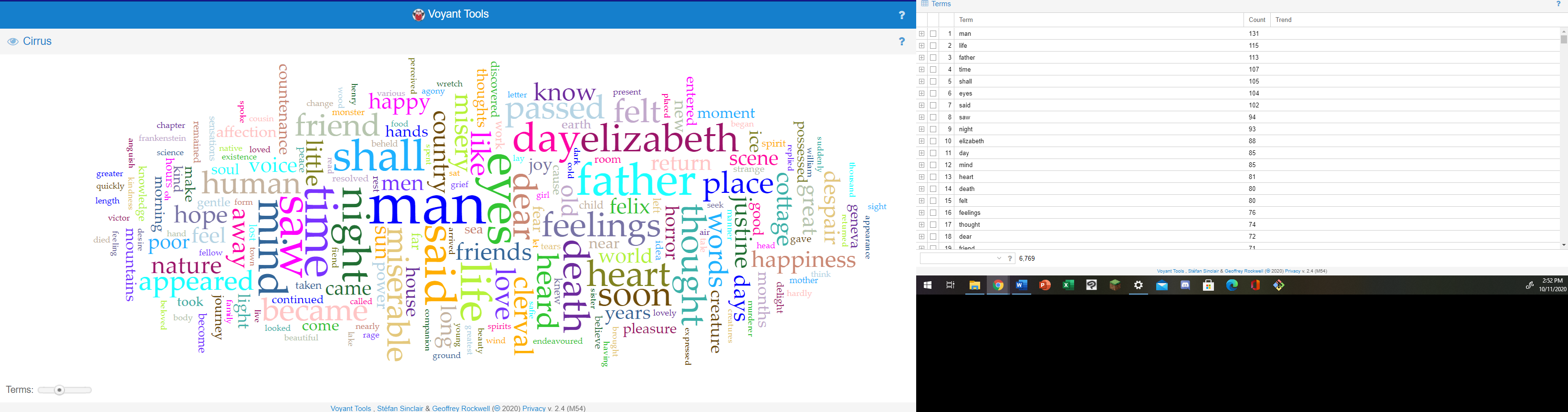
Frankenstein is an articulate story, so if Hamlet’s word count is high, then Frankenstein’s is higher. The most common terms in the story refer to life, the monster, and the emotions the characters feel. The concept of humanity, the creation of life, the degrees of sapience… If Hamlet’s theme of revenge of subtler than I remember, then Frankenstein is like having it drilled into my head. It’s mentioned so much that it’s impossible to forget, yet it’s themes are exactly why the story is remembered. Interestingly, monster is number 126 on the list of terms, with words such as fiend, creature, and horror being used more to describe the monster.
View the word cloud here and the term table here
Common Ground in Different Genres
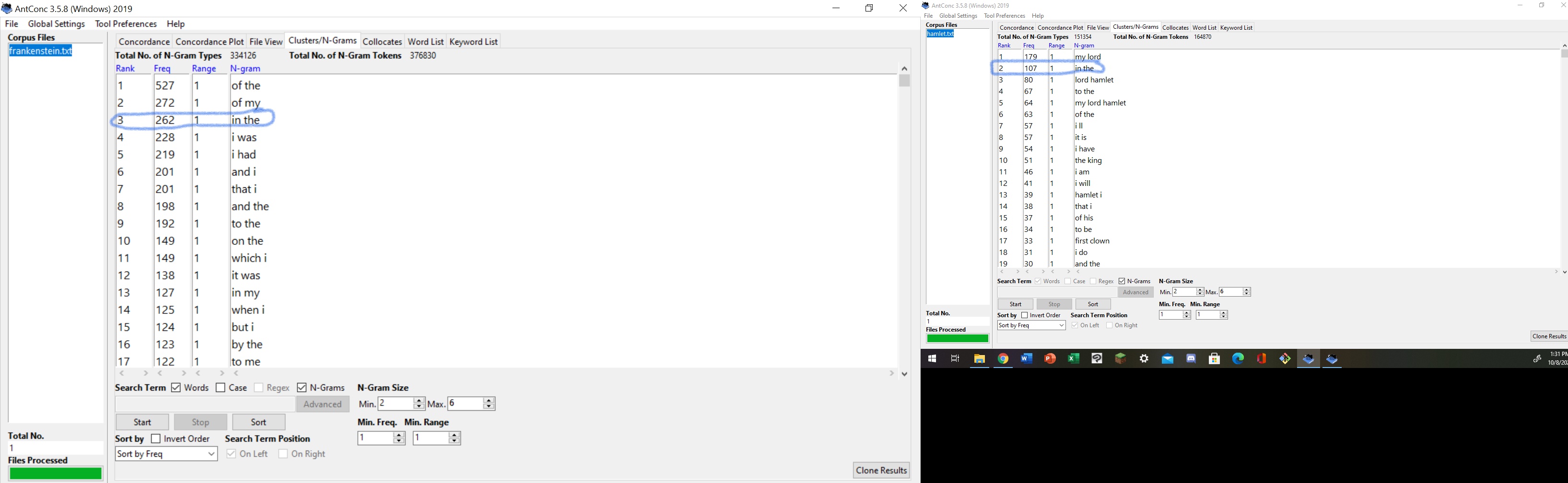
Both stories are told from a first-person perspective, meaning that “I”, “Me”, “My,” and “And” are common among the top N-grams. In fact, between each story, the phrase “in the” (pictured below) is the top three. These N-grams show that despite being written in differing genres and eras, their use of first-person is similar. Upon further analysis, I’ve noticed that there are several shared terms among the top 20, but I only screenshotted comparison, which I will discuss below.
View Frankenstein (left) and Hamlet (right)
Classically Different
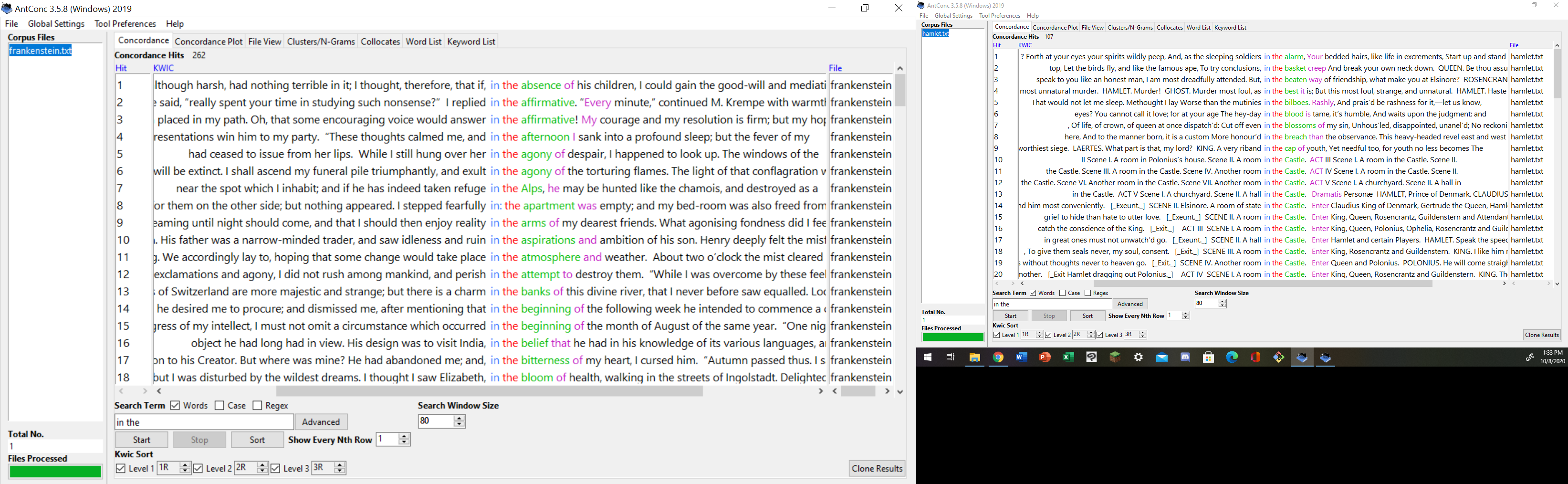
While many N-grams are shared between stories, their contexts are different. Viewing the Concordance tab for “in the”, I found a number of differences. Hamlet uses the phrase in the present tense, providing exposition and stage directions when it isn’t spoken, while Frankenstein uses the phrase in the past tense, emphasizing a setting or detail and is followed by an adjective. The biggest difference, however, is the presentation. They are eloquently written with words uncommon in the present, but Frankenstein is a nineteenth-century letter compared to Hamlet, a play that lay the foundation for generations of playwrites.
View Frankenstein (left) and Hamlet (right)